FDA Proposes New Rule for Foreign Tobacco Manufacturer Accountability

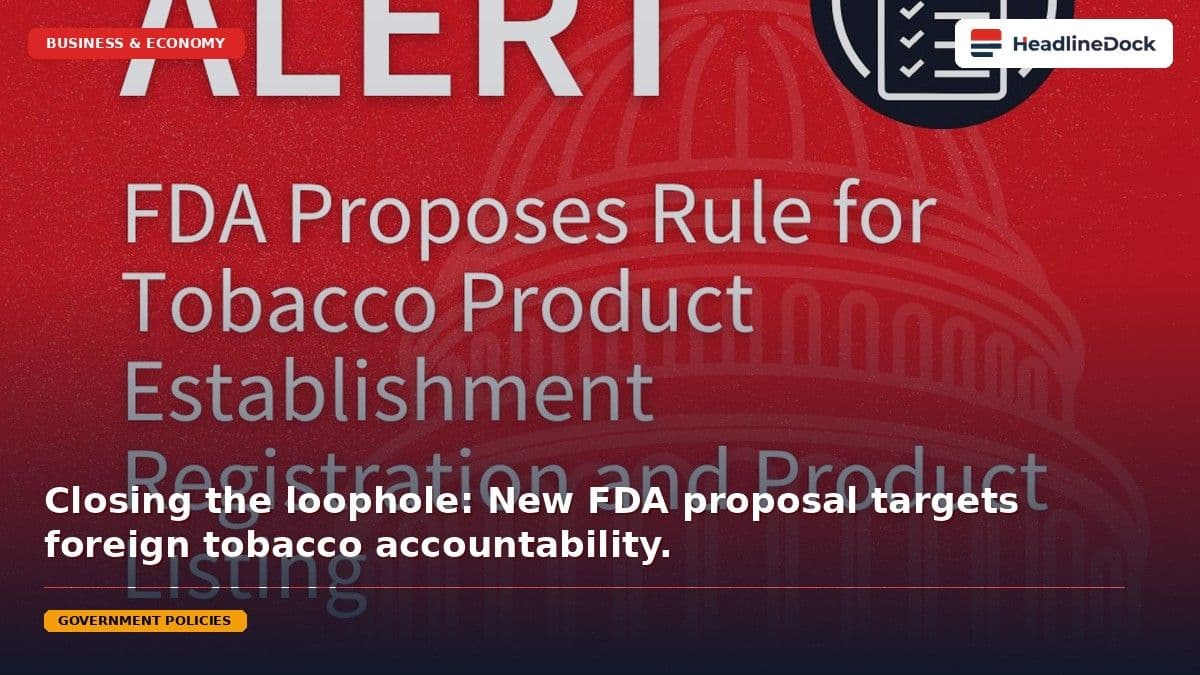
On June 26, 2026, the FDA introduced a proposed rule requiring foreign tobacco manufacturers to register their establishments and list products with the agency. This measure seeks to close regulatory gaps, particularly for imported e-cigarettes, by mandating transparency and technical disclosure consistent with existing domestic tobacco manufacturer standards.
Read it in Short
QUICK OVERVIEW
The FDA proposed a new rule requiring foreign tobacco manufacturers to register establishments and list products.

This mandate eliminates the current regulatory disparity between domestic and international tobacco product entities.
Foreign manufacturers must submit detailed hardware specifications, including e-liquid volume, battery, and wattage information.
The deadline for public comment on this proposed regulatory measure is September 14, 2026.
FDA Proposes New Rule for Foreign Tobacco Accountability
For years, the U.S. tobacco market has faced a significant regulatory disparity. While domestic manufacturers are bound by stringent registration and reporting requirements, foreign entities exporting products into the United States have operated in what many observers call a "regulatory blind spot." This gap has allowed a surge of unauthorized, often youth-appealing, e-cigarette products to flow into American commerce with limited oversight.
On June 26, 2026, the U.S. Food and Drug Administration (FDA) moved to rectify this imbalance. By proposing the rule "Establishment Registration and Product Listing for Tobacco Products" (Docket No. FDA-2025-N-7130), the agency is seeking to mandate that all foreign tobacco product manufacturers follow the same administrative paper trail as their domestic counterparts. This strategic shift represents an enforcement-first approach designed to protect public health by verifying compliance at the source.
Closing the Regulatory Gap
The core objective of this proposal is to ensure that every manufacturer—regardless of where their factory is located—is accountable to the FDA. Currently, the lack of a standardized registration system for international entities makes it difficult for regulators to track exactly what is entering the country. By requiring foreign manufacturers to register their establishments and list their products, the FDA gains a clearer view of the supply chain.
This is not merely a bureaucratic exercise. When a manufacturer registers, they provide a roadmap of their operations. Under the proposed rule, this includes not just basic company information, but granular technical specifications. For the vaping industry, this means declaring specific details like e-liquid volume, battery components, and wattage, which are critical metrics in identifying unauthorized or non-compliant hardware.
Comparison of Regulatory Requirements
The proposed rule creates a uniform playing field, ensuring that the oversight applied to U.S.-based facilities is extended to global exporters. The following table highlights the consistency the FDA aims to achieve:
| Feature | Domestic Manufacturers | Foreign Manufacturers (Proposed) |
|---|---|---|
| Registration Requirement | Mandatory | Mandatory |
| Electronic System | Required | Required |
| Annual/Bi-annual Updates | Yes | Yes |
| Labeling Records (4-Year Retention) | Yes | Yes |
| Hardware Specs | Tracking/Nicotine | Nicotine + Battery/Wattage/Vol |
Why This Matters for Public Health
Historically, the FDA has been forced to play a game of "whack-a-mole" at the U.S. border, attempting to intercept illicit products as they arrive. By moving the point of accountability upstream to the factory level, the FDA can identify and flag non-compliant facilities before their products reach the distribution stage.
Industry analysts, such as Azim Chowdhury and Bryan Haynes, have characterized this as a "long-awaited" measure. The rule addresses the unfair competitive advantage previously held by foreign entities that could bypass the administrative overhead costs borne by domestic firms. By forcing transparency, the agency is signaling that entry into the U.S. market is contingent upon strict adherence to established safety and identification standards.
Navigating Potential Challenges
While the proposal is widely viewed as a necessary evolution of tobacco control, it is not without potential hurdles. Critics and legal observers have noted that the FDA’s jurisdictional reach into sovereign nations is complex. The feasibility of conducting meaningful, on-site international inspections remains a point of contention.
Furthermore, the FDA will face the logistical challenge of managing a massive influx of registration data. Ensuring the system remains accurate and that manufacturers actually report changes—such as new battery specs or flavor variants—will require robust digital infrastructure. As the industry approaches the September 14, 2026, public comment deadline, these concerns will likely be at the forefront of the discourse between regulators and the global tobacco industry.
Ultimately, this rule serves as a critical modernization of the FDA’s toolkit. By requiring foreign manufacturers to document their production, the agency is taking a substantial step toward curbing the influx of unauthorized products and ensuring that every nicotine delivery system sold in the U.S. is subject to federal oversight.
Frequently Asked Questions
What is the purpose of this FDA tobacco rule?
It mandates that foreign tobacco manufacturers register their facilities and products with the FDA, ensuring they are held to the same accountability standards as domestic U.S. companies.
Does this regulation affect all types of tobacco products?
Yes, the rule applies to all establishments that manufacture, prepare, compound, or process tobacco products for the U.S. market, including e-cigarettes and vaping hardware.
How must foreign tobacco manufacturers submit their compliance data?
Most data must be submitted electronically through the FDA’s official online registration system to ensure standardized processing and tracking.
When will the new FDA foreign tobacco rule take effect?
It is currently a proposed rule. It will not take effect until the public comment period closes on September 14, 2026, and the FDA issues a final regulation.