Reimagining Higher Education With The Innovative Waterloo Futures Lab Workshop


The Waterloo Futures Lab is an intensive eight-week workshop partnership between Google and the University of Waterloo. It trains students from diverse majors to build AI-powered tools using Google technologies, helping them transition from academic theory to industry-ready roles through rapid prototyping and interdisciplinary team-based collaboration.
Read it in Short
QUICK OVERVIEW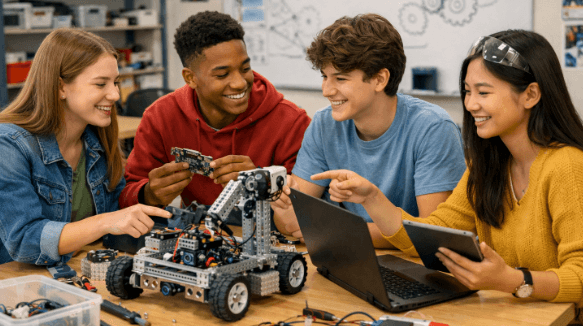
An 8-week intensive workshop bridges the gap between academic theory and industry demands.
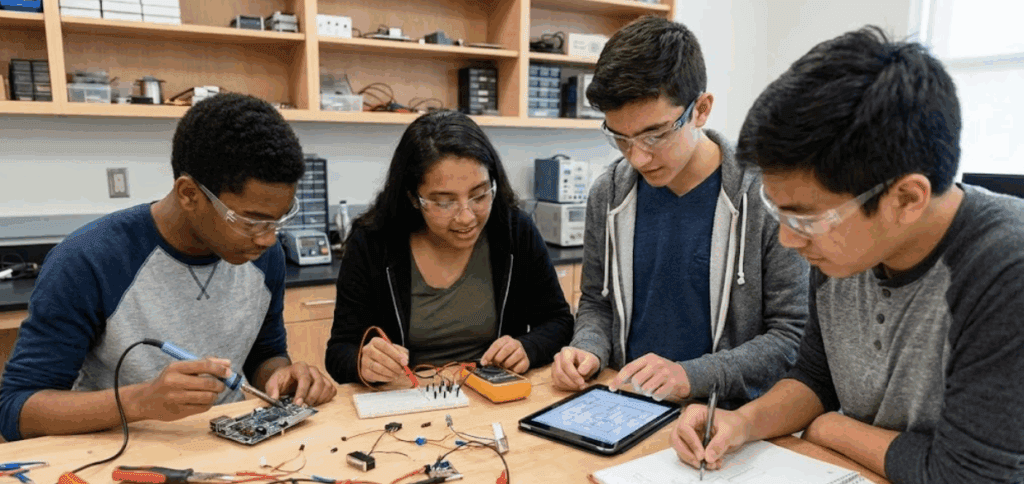
The lab uses Google Gemini models and Google AI Studio for hands-on, rapid AI prototyping.

Students from all majors collaborate to create functional AI tools, emphasizing interdisciplinary problem-solving.
Program graduates gain a competitive edge in job markets through career-readiness and real-world project experience.
Reimagining higher education with the Waterloo Futures Lab
For many university students, the rapid acceleration of artificial intelligence has induced a profound sense of "AI anxiety." While traditional academic structures are built on multi-year curricula, the pace of the AI-first economy moves in weeks, not semesters. The Waterloo Futures Lab has emerged as an experimental solution to this misalignment, functioning as a high-velocity workshop designed to transform this anxiety into concrete, market-ready expertise.
Following an official impact report released on July 16, 2026, the collaboration between Google and the University of Waterloo is now being viewed as a gold-standard blueprint for how academia can bridge the gap between abstract theory and real-world industrial demand.
The Anatomy of the Lab
At its core, the Waterloo Futures Lab is an intensive eight-week workshop that strips away the academic insulation of the traditional classroom. Students do not spend their time simply reading about AI; they use Google’s Gemini models and Google AI Studio to move through the entire product lifecycle—from ideation to functional prototype.
Led by Professor Edith Law, the program moves beyond the domain of Computer Science. By prioritizing interdisciplinary teams, the lab actively recruits students from fields like biology, finance, and environmental conservation. This diversity is intentional; it ensures that the resulting tools address genuine, complex problems rather than just technical exercises.
Key Competencies Developed
- "Vibe coding": A focus on rapid, intuitive prototyping that prioritizes speed and functional iteration over heavy-duty software engineering.
- Rapid storytelling: Students are required to distill complex technical utility into 30-second pitches, a skill designed to demonstrate value to stakeholders or recruiters.
- Design thinking: Moving from a blank canvas to a user-centric AI interface under tight deadlines.
Comparison: Traditional Computer Science vs. The Futures Lab Model
| Feature | Traditional CS Curriculum | Waterloo Futures Lab |
|---|---|---|
| Focus | Deep theory and syntax | Applied UX and AI prototyping |
| Speed | Semester-long projects | 8-week rapid iteration |
| Scope | Department-specific | Highly interdisciplinary |
| Goal | Academic mastery | Market-ready career readiness |
Why This Shift Matters
The value of the Waterloo Futures Lab lies in its rejection of "tradition over agility." In the modern job market, an entry-level candidate who has already navigated the constraints of API limits, model hallucinations, and user experience design is inherently more employable than one who has only studied the theoretical underpinnings of neural networks.
By securing a $1 million investment from Google to establish the "Google Chair in the Future of Work and Learning," the program has ensured that mentorship flows directly from industry practitioners to the students. This creates a feedback loop where the curriculum itself is in a constant state of refinement based on the latest industry developments.
Troubleshooting Your AI Prototyping
As an experimental program, the lab encourages students to view "bugs" as learning milestones. If you are developing your own AI tools and encounter common roadblocks, consider the following troubleshooting workflow:
- Model Hallucinations: If your prototype provides inaccurate data, pivot from general prompts to "few-shot" prompting. Provide the model with 3-5 high-quality examples of the output you expect to ground its reasoning.
- Interface Friction: If users find your tool confusing, remember the 30-second rule. If your tool cannot demonstrate its core utility in under 30 seconds, the UX is too complex. Simplify the user input flow.
- API Limitations: Always build with fallback error handling. AI tools are inherently unpredictable; ensure your UI provides a clear, helpful message when a model request fails, rather than simply freezing.
A Proven Trajectory
The program has already seen significant success with student-led projects. Tools like SignFluent, an ASL learning aid, and Kanji Garden, an AI-generated language tool, have showcased the efficacy of the lab’s methodology. With the one-year impact report now in public view, the Waterloo Futures Lab stands as a testament to the fact that when industry and academia align on the goal of "career readiness," the result is not just better graduates, but a better-equipped workforce for the AI era.
📖 Google Coverage Timeline (Story Graph)
Follow the chronological evolution of Google updates and related announcements on HeadlineDock:
- Jun 18, 2026 — Preity Zinta to Sue Google and Meta Over Unauthorized AI-Generated Content
- Jun 19, 2026 — How to Reduce Social Media Addiction with 5 Simple Tweaks
- Jun 22, 2026 — Google Data Centre Project Sparks Major Land Row in Visakhapatnam
- Jun 24, 2026 — YouTube Reaches Settlement in Legal Case Regarding Social Media Harm to Youth
- Jul 04, 2026 — Google Loses Final Appeal Against Record $4.7 Billion European Antitrust Penalty
- Today — Active Coverage: (You are reading this article)
Frequently Asked Questions
Who can apply to the Waterloo Futures Lab?
The lab is open to university students across diverse majors, explicitly encouraging those from non-technical backgrounds to apply.
Is the program only for Computer Science students?
No. A core goal is interdisciplinary collaboration, bringing together students from fields like biology, finance, and environmental conservation.
What kind of projects do students build?
Students build AI-powered prototypes to solve learning or productivity challenges, such as the ASL learning tool SignFluent or the language tool Kanji Garden.
Does this program guarantee a job at Google?
While not a formal job placement program, students gain career readiness and credibility used as competitive talking points during co-op and employment interviews.
Related Articles
 NBA Tests New Free-Throw Rules and Smart Ball Technology This Summer
 ITV Upgrades ITVX Streaming Platform With New Edge Video Delivery Technology
 Shakira Partners With Global Citizen To Support Educational Relief In Venezuela
Government Unveils Strategic Defence Investment Plan Prioritizing Autonomous Drone Technology