Avatar Exhibition Traces 1,500 Years of Vishnu Art in Sydney
The Art Gallery of New South Wales presents a comprehensive exhibition featuring 200 artworks that trace 1,500 years of history through the avatars of the Hindu deity Vishnu, reflecting on themes of order, morality, and human transformation in a modern context.
Highlights
- •The Art Gallery of New South Wales is hosting a major exhibition featuring 200 artworks spanning 1,500 years.
- •The collection explores the Hindu deity Vishnu and his avatars as symbols of order and moral guidance.
- •Rare artifacts, including ancient Cambodian sculptures, are on display for the first time outside their origin countries.
- •Contemporary artists like Desmond Lazaro and Sumakshi Singh feature alongside historical pieces to bridge past and present.
The Art Gallery of New South Wales has unveiled a major exhibition that explores 1,500 years of history through the lens of Hindu mythology. Titled Avatar: Forms of Vishnu, the showcase provides a timely reflection on the concept of divine incarnations and their capacity to restore order to a troubled world. By tracing the iconography and narratives of Vishnu, the exhibition offers a poignant art exhibition experience that resonates with contemporary challenges.
For over 15 centuries, Vishnu has been revered in Hindu traditions as the sustainer of dharma, representing morality, righteousness, and cosmic balance. Traditionally depicted with blue skin to signify his divine nature, the deity is celebrated for his various human and animal manifestations. The current exhibition at the Art Gallery of New South Wales brings together 200 significant artworks, many of which are being displayed outside their home countries for the very first time.
Exploring the Significance of the Avatar Exhibition
The term avatara, from Sanskrit, literally translates to “descent.” In the context of this art exhibition, the curators examine Vishnu not merely as a figure of religious worship, but as an omnipresent force capable of taking on diverse personas. By juxtaposing ancient artifacts with modern artistic expressions, the display highlights how these centuries-old stories remain relevant amidst today's political divisions and environmental instability.
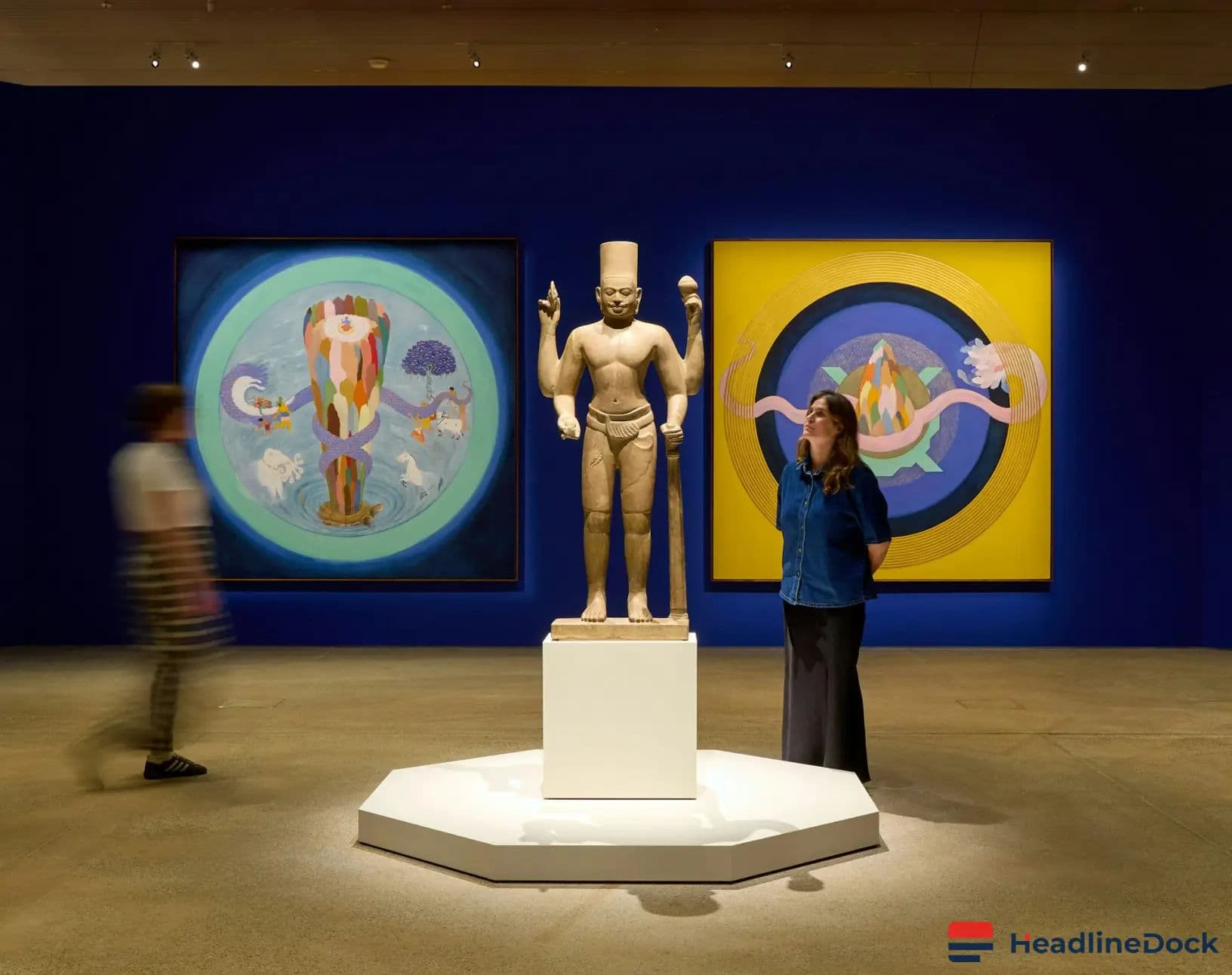
The collection features a diverse array of media, including bronze, textiles, gold, and intricately carved stone. A standout piece includes a 9th-century sandstone sculpture from Cambodia, which stands as a testament to the historical reach of these narratives. This ancient work is thoughtfully paired with the contemporary vision of artist Desmond Lazaro, whose paintings illustrate foundational myths such as The Churning of the Ocean of Milk.
Another highlight of the Avatar: Forms of Vishnu exhibition is the installation Threshold, a silk and cotton work by Sumakshi Singh. It frames a 13th-century stone carving of Lakshmi Narasimha, emphasizing the connection between classical artistry and modern creative interpretation. The exhibition also delves into the importance of female consorts, whose shakti or energy is depicted as essential to the success of the avatars’ missions.
The showcase concludes with an exploration of Vishnu’s Cosmos, featuring portable folding storyboards known as kaavad alongside 19th-century oleographs. These items illustrate how the mythology has adapted over time to include modern symbols. As the first Australian exhibition dedicated entirely to Vishnu, this event acknowledges the growing cultural presence of South and Southeast Asian communities in the region. Visitors can explore this profound artistic journey in Sydney until October 5.