President Trump Declares Iran Ceasefire Over Following Renewed Middle East Tensions

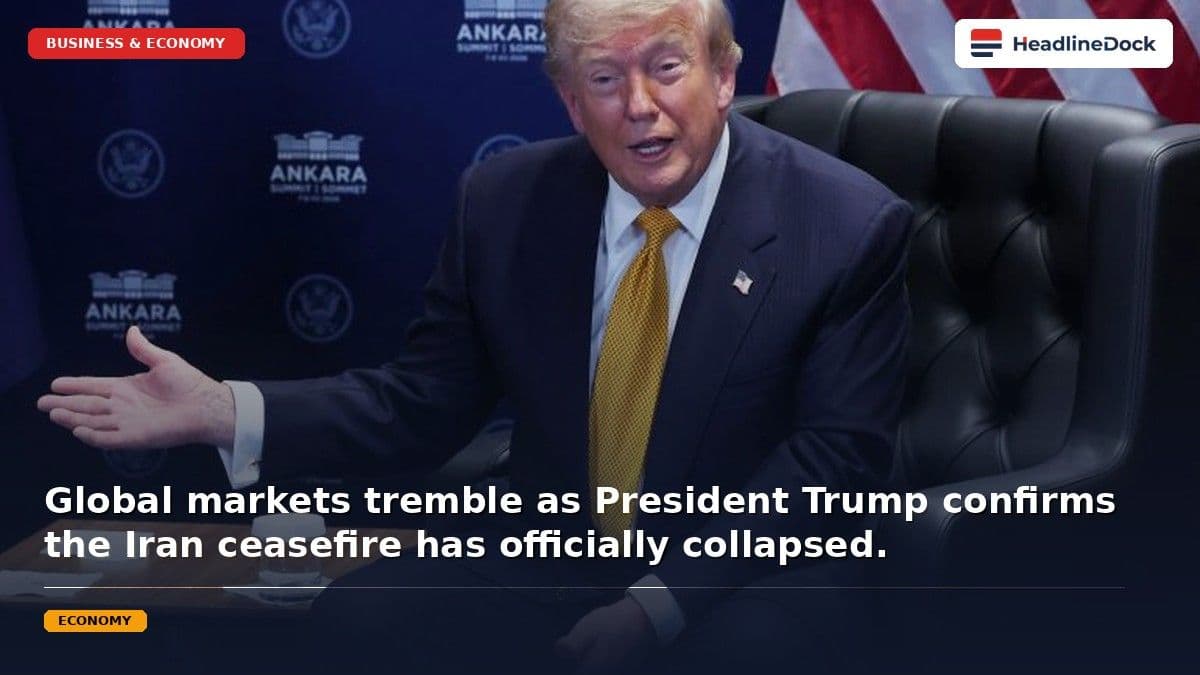
President Donald Trump has declared the U.S. ceasefire with Iran over, citing recent hostilities. The announcement, delivered at the NATO summit, follows U.S. strikes on critical infrastructure, triggering a surge in oil prices and significant volatility across global financial markets.
STORY IN BRIEF
QUICK OVERVIEW
President Trump declares the ceasefire with Iran is over following renewed hostilities in the Middle East.

The U.S. is targeting critical infrastructure, with specific attention on the strategic oil hub of Kharg Island.

Global markets reacted sharply to the instability, with the Dow Jones dropping and oil prices surging significantly.
In a major policy shift, the U.S. may allow Ukraine to manufacture its own Patriot missile defense systems.
The geopolitical situation involving Iran has escalated significantly as United States President Donald Trump declared the existing ceasefire officially over. Speaking at the NATO summit in Turkey, the president expressed his refusal to continue engagement, characterizing the recent developments as a critical breakdown in diplomatic efforts.
The announcement follows a series of military actions conducted by the U.S. in response to attacks on commercial vessels near the Strait of Hormuz. President Trump has explicitly warned that further strikes on Iran, particularly targeting critical infrastructure, are imminent. The administration has focused heavily on Kharg Island, a vital site that facilitates approximately 90% of the nation's crude oil exports. Military strategists have long viewed the island as a strategic nexus for the country's oil distribution capabilities.
Geopolitical Risks and Market Volatility
The instability surrounding Iran has sent immediate shockwaves through global financial markets. On Wednesday, the Dow Jones Industrial Average dropped significantly, reflecting investor anxiety over the re-emergence of conflict in the region. Furthermore, oil prices surged, with international Brent crude climbing sharply as markets recalibrate their risk assessments. Analysts note that while there was an initial assumption of a move toward de-escalation, recent military actions indicate that a lasting agreement is currently unlikely.
In addition to these developments, the administration announced a notable shift regarding Ukraine. During his discussions in Ankara, Trump indicated that Ukraine might be permitted to manufacture Patriot missile defense systems domestically. This policy pivot suggests a major shift in the U.S. approach to supporting its allies' defense capabilities against regional aggression.
The response from Iranian officials has been defiant. Members of the Iranian parliament have issued strong warnings, signaling their commitment to defend national territory against any potential military escalation. As global leaders watch the situation closely, the combination of energy security concerns and shifting military alliances continues to dominate the discourse at the ongoing summit. Financial observers remain cautious, as the uncertainty regarding Iran suggests that market volatility may persist until a clearer path to regional stability is established.