US Charitable Giving Surpasses $600 Billion Milestone for the First Time
Charitable giving in the U.S. climbed to a record $617 billion in 2025, driven by significant bequests and foundation support. While education and public-society benefit categories saw strong growth, individual contributions remain influenced by wider economic conditions and upcoming tax policy changes.
Highlights
- •Total U.S. charitable giving hit a record $617 billion in 2025, a 3% annual increase.
- •Charitable bequests grew by 16.6% to $62 billion, driven by the ongoing wealth transfer and market gains.
- •The education sector experienced the highest growth, with donations rising by 8.9% to reach $92 billion.
- •New federal tax measures taking effect in 2026 are expected to broaden the base of individual charitable donors.
Charitable giving in the United States experienced a notable upswing during 2025, reaching a historic milestone as total donations surpassed the US$600 billion threshold for the first time. This surge, representing a 3% growth compared to the previous year, highlights a dynamic landscape for philanthropy, even as the nation navigated complex economic signals.
The total figure of $617 billion represents the second-highest level of donations in inflation-adjusted history, trailing only the record established in 2021 during the peak of pandemic-related social relief efforts. While this growth rate slightly exceeds the long-term annual average of 2.7%, it occurs amidst a mixed economic backdrop, characterized by robust stock market performance contrasted with low consumer sentiment and persistent inflationary pressures.
Drivers of Growth in Philanthropic Contributions
The expansion in charitable giving was largely propelled by significant contributions from estates and private foundations. Charitable bequests, which are gifts designated after an individual's passing, played a pivotal role by accounting for roughly 10% of total U.S. donations in 2025. These gifts grew by 16.6% to reach $62 billion, marking a significant upward trajectory as substantial wealth transfers occur across the nation.
The performance of the stock market has directly influenced these trends. Elevated asset values have increased the net worth of many wealthy donors, often leading to larger bequests. For instance, the estate of Microsoft co-founder Paul G. Allen contributed a noteworthy $3.1 billion bequest, underscoring how individual large-scale gifts can significantly impact annual totals. Similarly, private foundations, mandated by law to distribute at least 5% of their assets annually, have leveraged increased endowment values to drive their contributions to a record $117 billion.
In contrast, individual giving grew by a more modest 1.4%, totaling 64% of the overall share. Despite this, corporate support reached a record high, with businesses providing $44 billion in charitable aid, reflecting a nearly 30% increase since 2020 when adjusted for inflation.
Sector-Specific Trends and Future Outlook
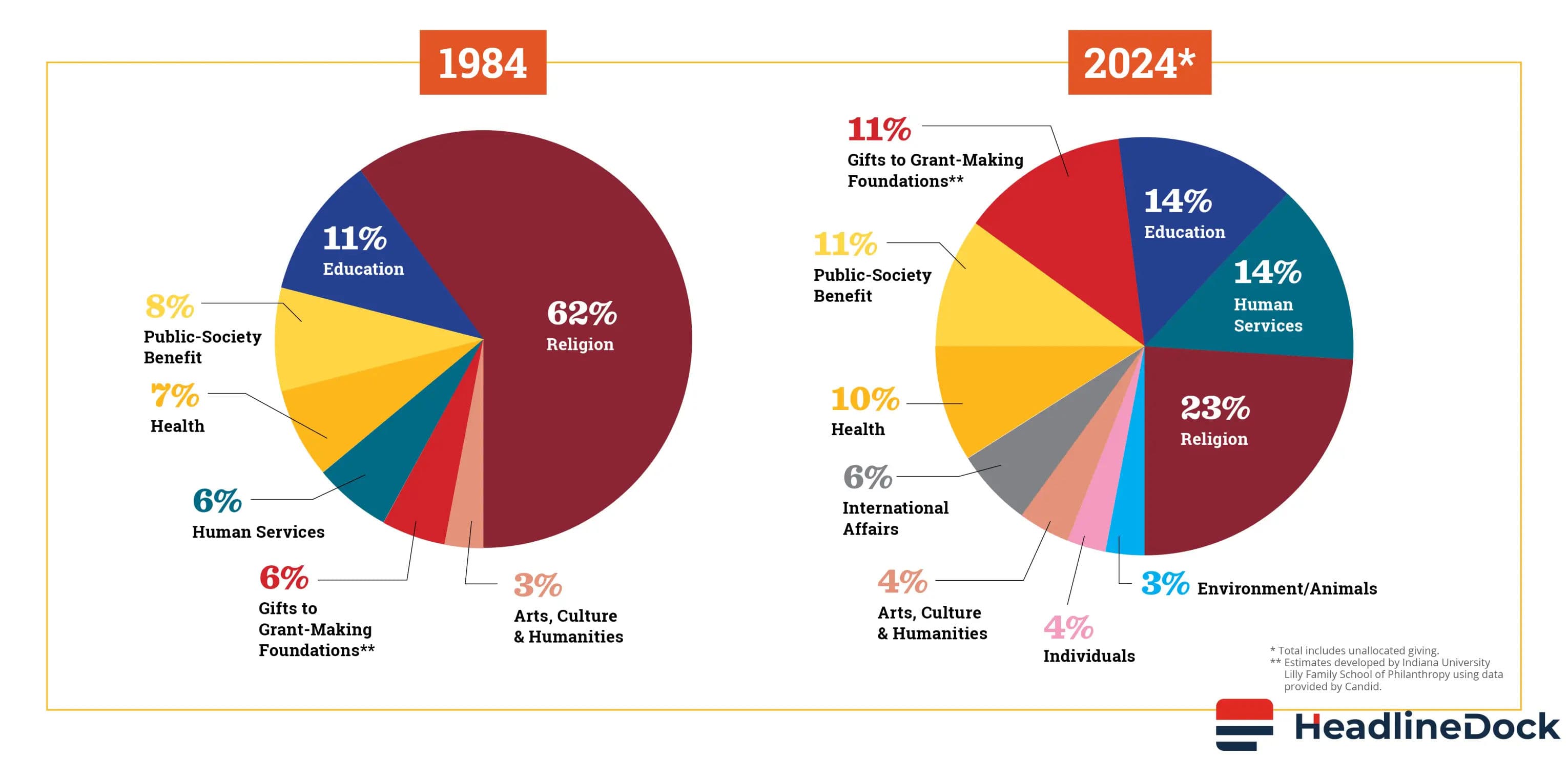
The distribution of donations varied across different sectors. Education saw the most significant growth, with contributions rising 8.9% to an all-time high of $92 billion. Public-society benefit organizations also benefited from an 8.7% increase. Conversely, giving to houses of worship remained essentially stagnant, reflecting a long-term trend, while donations to foundations experienced a decline following an exceptionally strong performance in 2024.
Looking ahead, the philanthropic environment may see further shifts in 2026. Legislative changes, including the implementation of a universal charitable deduction as part of federal tax and spending measures passed in July 2025, are expected to incentivize a broader base of taxpayers to participate in charitable activities. These developments suggest a continued evolution in how individuals and institutions approach charitable giving in the years to come.