Pacific Nations Condemn China After Ballistic Missile Test Near Tuvalu

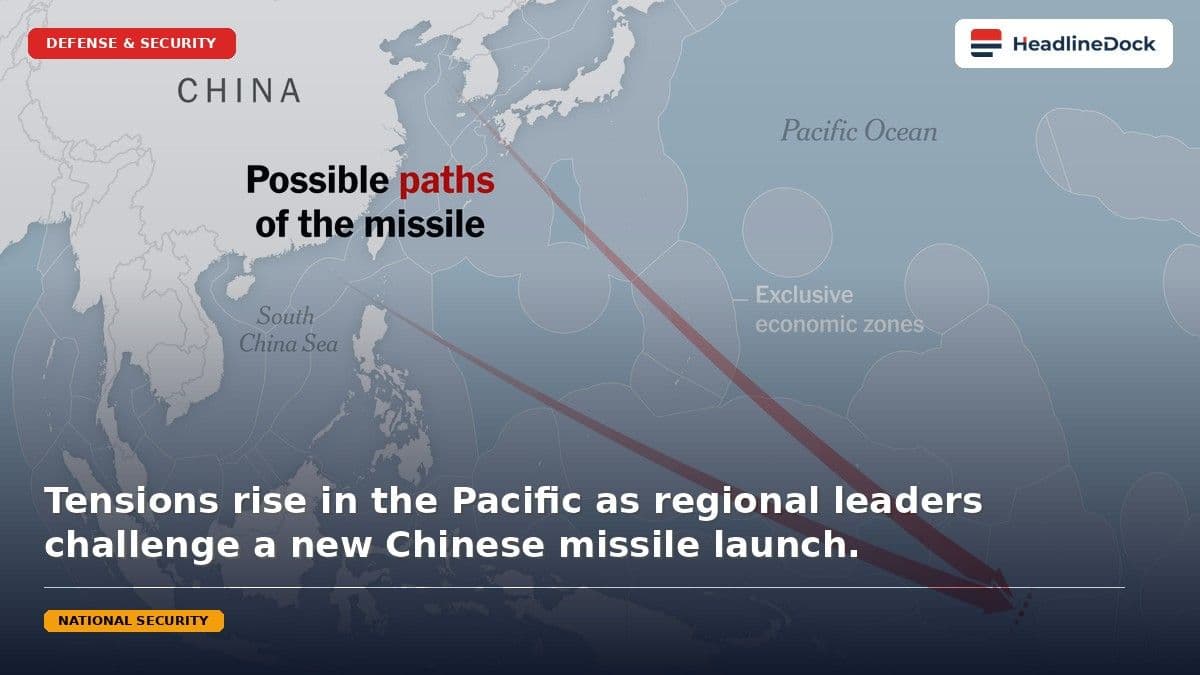
Pacific Island nations are expressing strong opposition following a recent Chinese ballistic missile test near Tuvalu. Prime Minister Matthew Wale of the Solomon Islands joined other regional leaders in condemning the launch, citing concerns over regional security and the use of the Pacific for military displays.
KEY TAKEAWAYS
1 MIN READ- China test-fired a JL-3 submarine-launched ballistic missile that landed near Tuvalu and Kiribati.
- Solomon Islands Prime Minister Matthew Wale lodged a formal protest, warning against regional intimidation.
- The missile has an estimated range of over 10,000 km, capable of reaching the US mainland.
- The US, Australia, and Philippines criticized the launch as a provocative and destabilizing military display.
Pacific Island nations have voiced significant alarm following a recent missile test conducted by China. On July 6, 2026, the Chinese military launched an intercontinental ballistic missile (ICBM), specifically identified by experts as a JL-3 submarine-launched ballistic missile (SLBM). The test involved the projectile traversing the exclusive economic zones (EEZs) of several sovereign island nations before landing in international waters near the borders of Tuvalu and Kiribati.
The incident has sparked a diplomatic backlash across the region. Solomon Islands Prime Minister Matthew Wale issued a strong protest, stating that while the two nations maintain friendly relations, such displays of military force are unacceptable. Addressing the situation in Honiara, the Prime Minister emphasized that Pacific nations do not wish to be the target or the transit zone for long-range nuclear-capable weaponry, urging China to refrain from intimidating its regional partners.
Regional Security Concerns Intensify
The missile test has been viewed by international observers as a deliberate show of military capability, with experts noting that the JL-3 boasts a range exceeding 10,000 kilometers, placing the United States mainland within its potential reach. This development has heightened anxieties regarding the shifting security landscape in the South Pacific, a region historically sensitive to nuclear activities due to past international testing programs.
Global powers and regional neighbors have reacted swiftly to the development. The United States Department of State criticized the test, labeling the rapid and opaque expansion of Chinese nuclear forces a major concern for global security. Meanwhile, leaders in Australia and New Zealand have echoed these concerns, noting that while they received limited advance notification, the lack of prior consultation is increasingly becoming a point of friction.
Furthermore, the Philippines defense authorities condemned the launch as a provocative demonstration of power, describing it as a calculated act of intimidation. Security analysts suggest that this event underscores the growing difficulty China faces in balancing its economic influence with its military ambitions in the Pacific. As island nations continue to prioritize regional security cooperation, the pressure on Beijing to demonstrate more responsible conduct is expected to grow. The incident highlights the precarious nature of international relations in the South Pacific, where non-proliferation treaties like the Rarotonga Treaty remain central to regional identity and safety.