ISRO Achieves Success in High-Thrust Semi-Cryogenic Engine Hot Test Phase
The Indian Space Research Organisation has successfully conducted a 175-tonne thrust hot test of its semi-cryogenic engine at the Mahendragiri facility. This milestone, part of the development of the SC120 stage, aims to enhance the payload capacity and efficiency of the LVM3 launch vehicle.
Highlights
- •ISRO successfully conducted a 175-tonne thrust hot test of its semi-cryogenic engine at the IPRC in Mahendragiri.
- •The test of the Power Head Test Article (PHTA) focused on steady-state operation and turbopump performance.
- •This engine is being developed to replace the current L110 core stage of the LVM3 launch vehicle.
- •The system uses cleaner, non-toxic propellants, specifically liquid oxygen and purified kerosene (isrosene).
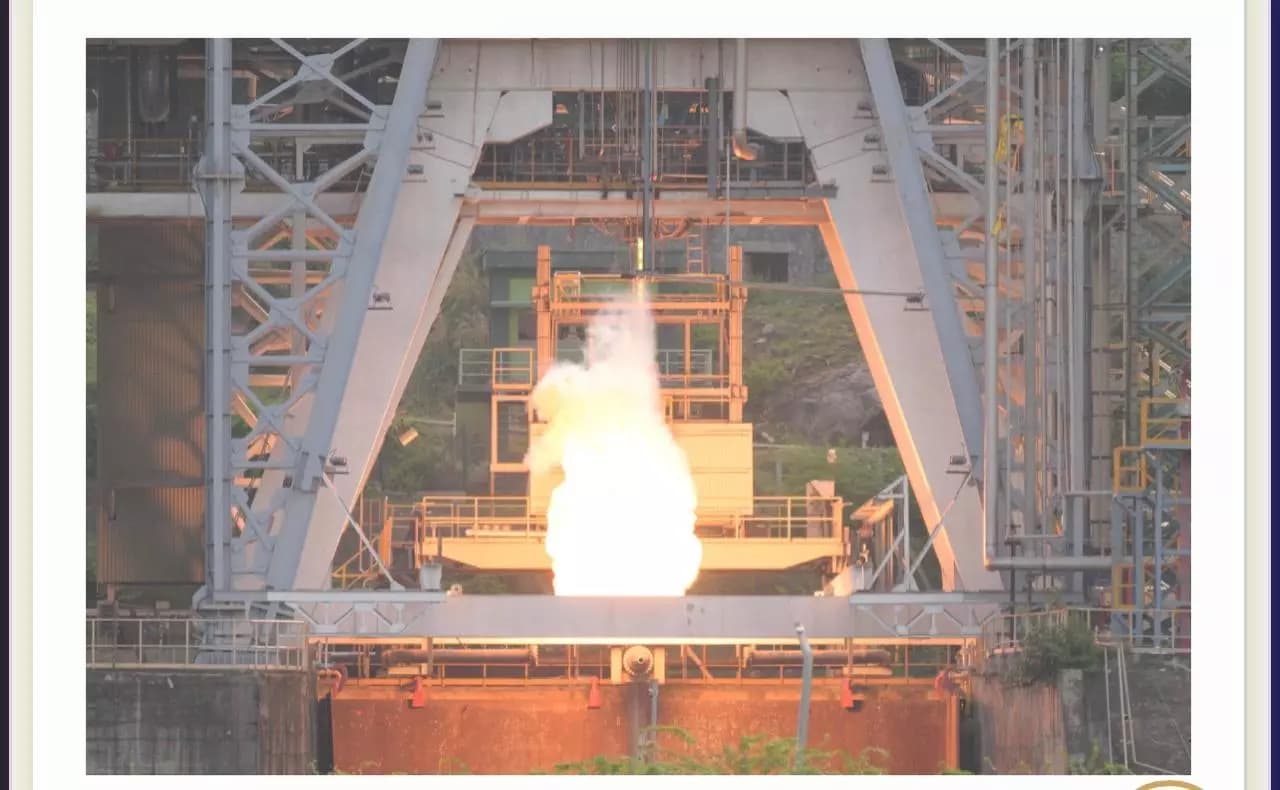
The Indian Space Research Organisation (ISRO) has reached a significant milestone in its aerospace capabilities by successfully conducting a hot test of a high-thrust semi-cryogenic engine. This crucial trial for the Semi-Cryogenic Engine Power Head Test Article (PHTA) took place on June 24, 2026, at the ISRO Propulsion Complex (IPRC) located in Mahendragiri, Tamil Nadu.
This event marks the eighth successful evaluation in an ongoing series of rigorous tests designed to validate the engine's performance under various conditions. During this latest iteration, the semi-cryogenic engine was operated at a thrust level of 175 tonnes, representing approximately 88 percent of its maximum capacity. The primary focus of this phase was to examine the engine’s build-up process following ignition of the pre-burner and to confirm its ability to maintain steady-state operations at these elevated thrust levels.
Advancements in Semi-Cryogenic Propulsion Technology
The Power Head Test Article is a comprehensive assembly that includes all essential engine systems, intentionally excluding only the thrust chamber. In previous test sequences, engineers evaluated the hardware at 47 percent (94 tonnes) and 60 percent (120 tonnes) thrust levels. By scaling up to 175 tonnes, the ISRO team demonstrated the successful operation of the main turbopumps, which effectively delivered 400 and 500 bar outlet pressures. This achievement confirms that the development of the semi-cryogenic engine is progressing according to original projections and provides essential confidence for upcoming tests aimed at reaching the full 200-tonne (100 percent) thrust milestone.
This technological leap is part of a broader strategic upgrade to replace the current L110 core stage of the LVM3 launch vehicle with the more efficient Semi-Cryogenic Propulsion Stage (SC120). Driven by the 2000 kN-class SE2000 engine, this transition is intended to significantly bolster the payload-carrying capacity of future launches while simultaneously improving operational efficiency. Unlike traditional fuels, this semi-cryogenic system utilizes a cleaner, non-toxic combination of liquid oxygen and purified kerosene—often referred to as isrosene—to achieve superior propulsive results.
As the space agency continues its development roadmap, the integration of this advanced semi-cryogenic engine alongside an uprated cryogenic upper stage represents a pivotal advancement. It ensures that the LVM3 remains a highly competitive and robust launch vehicle capable of supporting increasingly complex space missions. The successful test in Tamil Nadu serves as a testament to the country's growing prowess in indigenous aerospace engineering and its commitment to refining the technology necessary for next-generation space exploration.