Government Increases Diesel and ATF Export Duty; Check Updated Rates and Regulations
The Central Government has raised export duties on diesel and aviation turbine fuel to manage market supply. While export levies have increased, domestic retail prices remain stable, and temporary measures have been set to reduce congestion at fuel stations nationwide.
Highlights
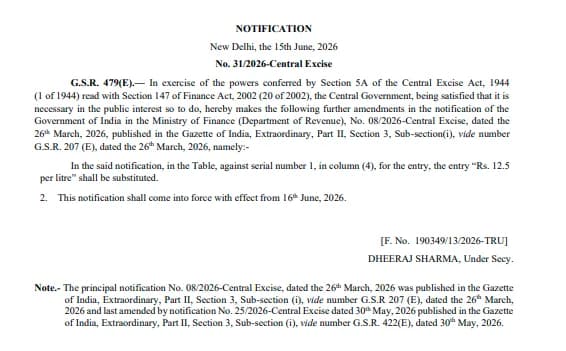
- •The government has increased export duties on Diesel to Rs 14 per liter and ATF to Rs 12.5 per liter.
- •Retail prices for petrol and diesel remain unchanged, ensuring no additional burden on domestic consumers.
- •The Ministry of Petroleum confirms that India maintains sufficient fuel reserves and refineries are operating at full capacity.
- •A temporary 200-liter daily limit on diesel purchases at retail pumps has been introduced to manage congestion.
The Central Government has implemented a significant update regarding fuel management, specifically focusing on the export duty levied on key petroleum products. Effective as of Tuesday, the administration has revised the financial levies on the export of Diesel and Aviation Turbine Fuel (ATF) to address shifting market dynamics.
Under the latest official notification released by the Department of Revenue, the updated export duty structure mandates a payment of Rs 14 per liter for diesel exports. Simultaneously, the export levy for Aviation Turbine Fuel has been adjusted to Rs 12.5 per liter. These adjustments are part of the government’s routine evaluation process, which occurs every two weeks to analyze international crude oil price fluctuations and refinery margins.
Understanding the Impact of Revised Export Duty
It is important to note that this policy shift is designed to optimize domestic supplies amidst complex geopolitical tensions and global oil market instability. While the export duty on these specific fuels has risen, the government has provided substantial relief to domestic consumers. The export levies on petrol remain unchanged, and crucially, there have been no adjustments to the excise duties on petrol or diesel sold within the local market. Consequently, retail fuel prices for citizens across the country will remain unaffected by these specific export-focused changes.
The Ministry of Petroleum has moved to reassure the public and industrial sectors that the nation maintains robust fuel reserves. During a recent inter-ministerial briefing, Joint Secretary Sujata Sharma emphasized that domestic refineries are operating at peak capacity, ensuring there is no shortage of crude oil, LPG, or natural gas. Authorities have encouraged both the public and commercial entities to exercise prudent energy conservation practices.
Managing Retail Fuel Station Congestion
In addition to the export duty adjustments, the government has introduced temporary measures to streamline operations at retail fuel outlets. Recent trends indicated a significant shift in consumption habits, with approximately 420 million liters of diesel sales moving from wholesale channels to retail petrol pumps throughout May. This migration created operational strain and congestion at retail locations.
To alleviate these logistical pressures, the authorities have instituted a temporary restriction of 200 liters per person per day for diesel purchases at retail stations. Large-scale commercial and industrial users are strongly advised to source their fuel requirements through dedicated consumer pumps rather than relying on public retail outlets. This regulatory measure is currently expected to remain in effect for a period of 90 days to ensure orderly fuel distribution and minimize inconvenience for individual commuters.