Uncertain Southwest Monsoon Puts Government on Alert for Kharif Season
With the southwest monsoon showing significant rainfall deficits, the government is intensifying efforts to manage agricultural risks. Concerns are mounting as reservoir levels remain low and meteorological experts predict a potential dry spell in July, impacting the critical Kharif crop season across multiple states.
Highlights
- •The southwest monsoon is experiencing a significant rainfall deficit of over 41% compared to historical averages.
- •Government officials have identified 315 vulnerable districts, with 111 labeled as high-priority due to irrigation concerns.
- •National reservoir storage levels have dropped significantly compared to the same period last year.
- •Expert analysis suggests current El Nino conditions may continue into 2027, impacting long-term weather forecasting.
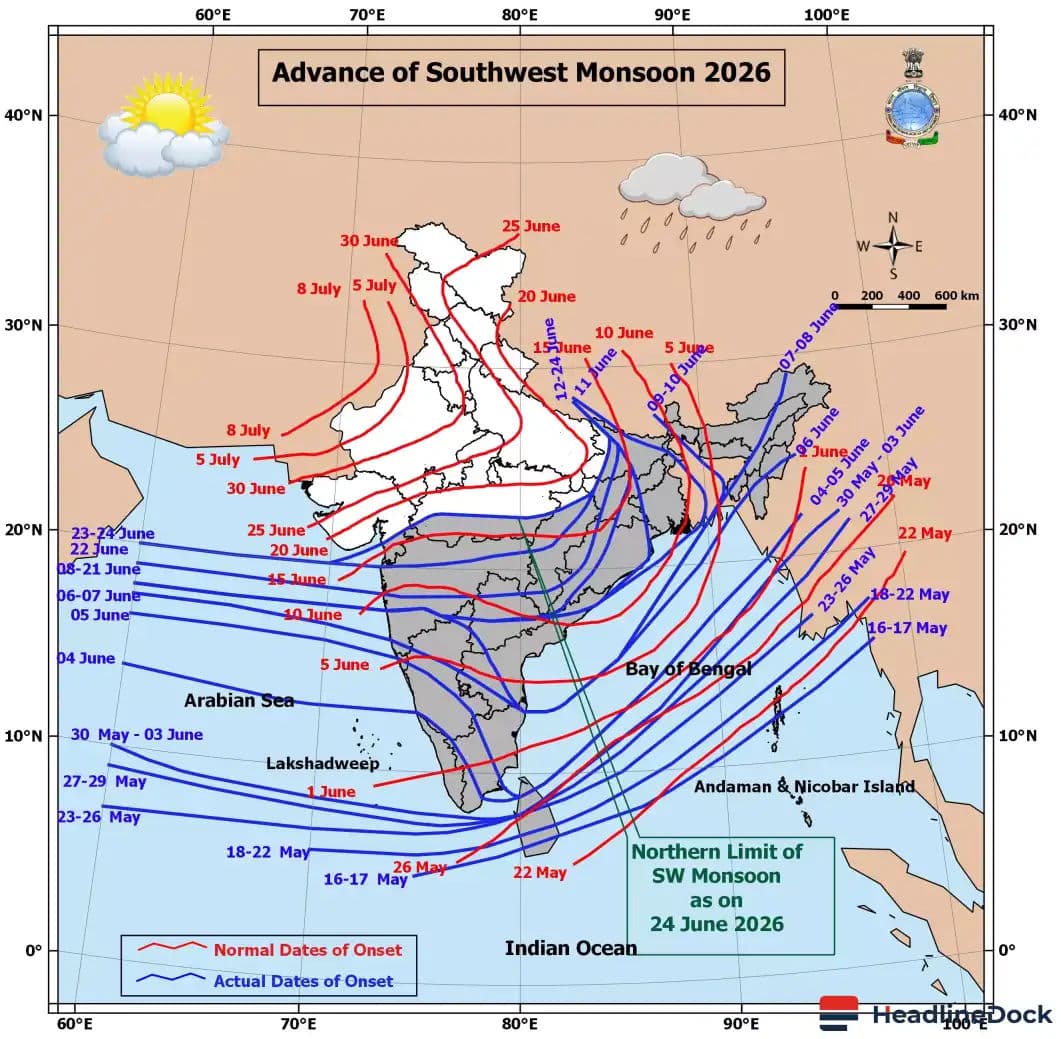
The southwest monsoon season is currently facing an uncertain trajectory, leading to growing apprehension within the central government regarding agricultural stability. With the rains displaying a sluggish progression across the country, officials anticipate a potential lull in precipitation during July, casting further doubts on the outlook for August and September.
Evaluating the Monsoon Impact on Agriculture
In response to the concerning weather patterns, the government has intensified its oversight of Kharif crop operations. Union agriculture minister Shivraj Singh Chauhan highlighted the proactive stance being taken, noting that 315 districts have been identified as particularly vulnerable to rainfall deficiencies. Among these, 111 have been designated as high-priority areas due to their limited irrigation infrastructure. The regions most at risk span across Madhya Pradesh, Maharashtra, Gujarat, Uttar Pradesh, Rajasthan, Karnataka, Bihar, Jharkhand, Telangana, Andhra Pradesh, and Odisha.
The India Meteorological Department (IMD) had previously forecasted a below-normal monsoon season, estimating rainfall at approximately 90 percent of the 50-year long-period average. This prediction was largely attributed to the formation of a strong El Nino event in the Central Pacific Ocean, which disrupts standard weather systems. Current data indicates a significant deficit, with the country recording 43 percent less rainfall than average thus far. Specifically, as of June 24, the actual rainfall reached 70 mm against an expected 119.9 mm.
Water Resource Management Concerns
Compounding the issue is the state of national reservoirs. According to assessments by the Central Water Commission, total storage levels on June 16, 2026, stood at 1,782.09 thousand million cubic feet (tmc ft), a notable decline from the 2,078.2 tmc ft recorded on the same date in 2025. This limited water availability requires careful management to bridge the gap until future seasonal replenishment.
Weather researchers, including Dr. Akshay Deoras from the University of Reading, suggest that while July may experience breaks in rainfall—typically lasting between five to ten days—the duration of these gaps will be critical for agricultural outcomes. Looking ahead, experts note that while the current El Nino conditions may persist into early 2027, historical trends offer some hope. Previous instances of strong El Nino events have often been followed by La Nina formations, which are generally favorable for the Indian southwest monsoon. For now, the nation remains focused on navigating the challenges of the ongoing season as farmers in key agricultural belts adjust their crop strategies to mitigate the risks posed by erratic rainfall patterns.