The Treaty of Versailles, Keynes, and German Reparations After the Great War
The Treaty of Versailles imposed heavy reparations on Germany after World War I, fueling economic crisis. This article examines the transfer problem, the debate between Keynes and Ohlin regarding debt, and how these financial burdens contributed to the eventual political instability of the Weimar Republic.
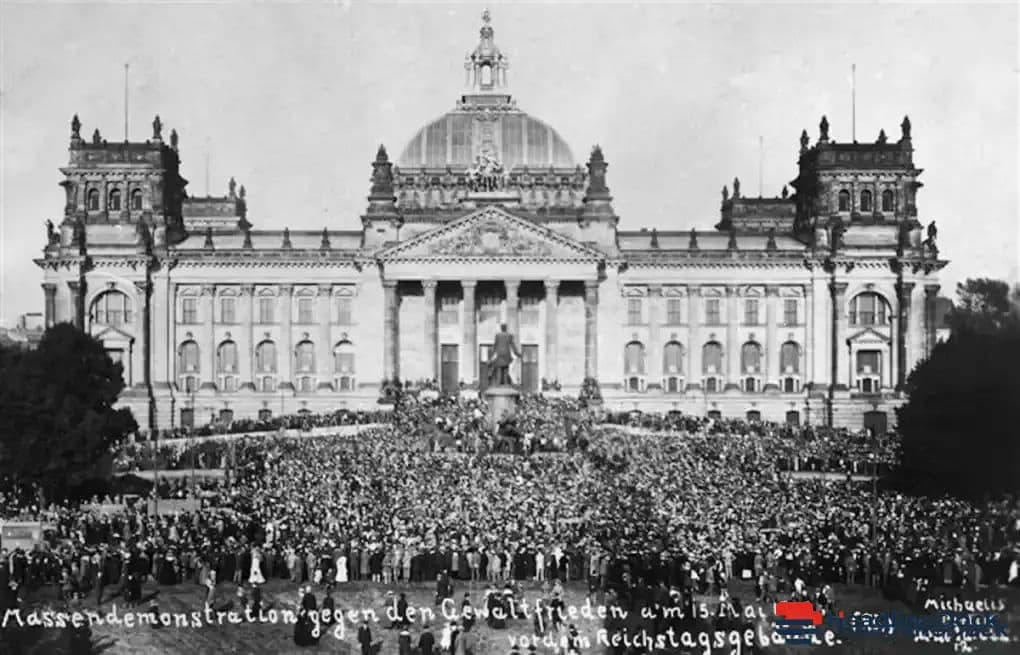
Following the conclusion of the First World War, often referred to as the Great War, the Paris Peace Conference convened in January 1919. This pivotal meeting brought together major Allied powers—the United States, France, the United Kingdom, and Italy—to determine peace terms for the defeated nations, including Germany, the Ottoman Empire, Bulgaria, Austria, and Hungary. Central to this process was the Treaty of Versailles, which established new borders for Germany and imposed significant financial penalties.
Under Article 231 of the Treaty of Versailles, Germany and its allies were held exclusively responsible for the war. This legal framework condemned Germany to pay war reparations totaling 226 billion marks to France and the United Kingdom. During the 1924 to 1929 period, the Weimar Republic relied heavily on massive loans from the United States to sustain its economy and manage these mandatory payments.
The Economics of the Treaty of Versailles
The 1929 stock market crash rendered the existing financial structure unsustainable, necessitating urgent debt renegotiations. Early efforts focusing on austerity and deflation proved unsuccessful. By 1930, the Young Plan was introduced, halving the debt to 112 billion marks. As global economic conditions deteriorated, the United States eventually forgave war debts owed by France and the United Kingdom between 1931 and 1932. Consequently, by 1932, Germany had achieved a reduction of over 98% of the debts originally mandated by the Treaty of Versailles.
A significant intellectual debate regarding these reparations emerged between British economist John Maynard Keynes and Swedish economist Bertil Ohlin. Keynes argued that forcing Germany to meet these extreme debt obligations through strict deflation would trigger social unrest, unemployment, and political instability. Conversely, Ohlin contended that the economic strain of the payments alone would be sufficient to facilitate the transfer of funds to creditor nations without necessitating harsh domestic austerity policies.
The logistical difficulty of transferring wealth from Germany to the Allies—known as the transfer problem—was largely mitigated until 1930 by American loans. Effectively, the gold Germany lost during the hyperinflation period of 1921–1923 returned to the country via the Dawes Plan as credit. This created a cycle where Germany paid France and the United Kingdom, who then repaid the United States, which in turn cycled capital back to Germany as debt, increasing the total interest burden.
The resulting economic instability paved the way for the ascent of Adolf Hitler. Following his appointment as Chancellor in 1933 and the subsequent consolidation of power after the death of Paul von Hindenburg, Hitler eventually halted all reparation payments in 1939. While the Treaty of Versailles is frequently cited as a catalyst for the collapse of the Weimar Republic, economic historians continue to analyze the relative impact of these reparations compared to other historical financial transfers.
,curated_key_highlights:[