PM Modi: India to Transform from Buyer to Global Defence Manufacturing Powerhouse
Prime Minister Narendra Modi announced that India is transitioning from a defence importer to a self-reliant manufacturer. Highlighting growth in defence production and exports, he emphasized that indigenous naval strength is essential for securing national prosperity, economic influence, and future employment opportunities for the youth.

Highlights
- •India aims to transition from a buyer to a major global manufacturer in the defence sector.
- •Defence production has grown significantly to ₹1.8 lakh crore with exports reaching ₹40,000 crore.
- •Over 40 indigenous warships have been inducted into the Indian Navy in recent years.
- •The maritime sector is highlighted as a critical engine for national job creation and prosperity.
During a recent official visit, Prime Minister Narendra Modi underscored a pivotal shift in the nation’s strategic approach, declaring that India will no longer be content as a mere consumer within the global defence production sector. Instead, the government is prioritizing a trajectory toward becoming a formidable, self-reliant manufacturer, aiming to transform the country into a decisive player on the international stage.
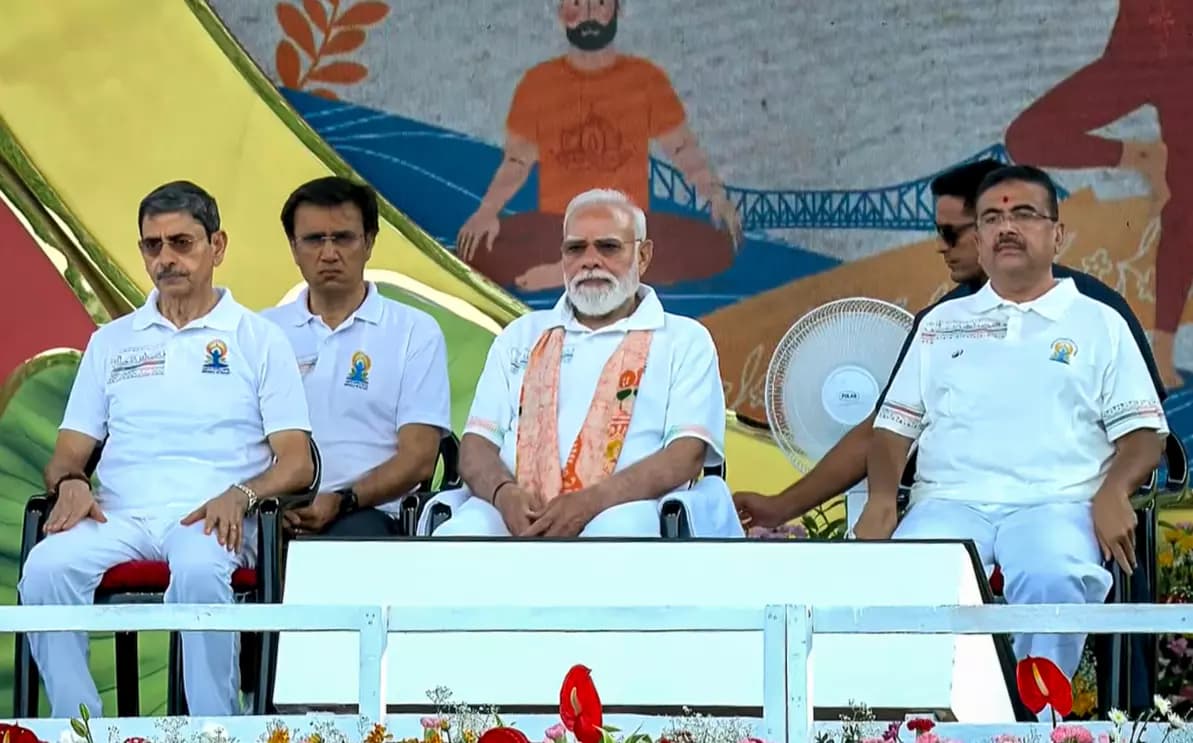
The Prime Minister addressed these ambitious goals while attending the tri-commissioning ceremony of INS Agray, INS Dunagiri, and INS Sanshodhak. These vessels, constructed by the defense public sector undertaking Garden Reach Shipbuilders & Engineers, were officially inducted into the Indian Navy in the presence of Navy Chief Admiral Krishna Swaminathan, West Bengal Governor R.N. Ravi, and Chief Minister Suvendu Adhikari.
Driving Indigenous Defence Manufacturing
Highlighting the evolution of India's military capabilities, Prime Minister Modi pointed out the dramatic rise in domestic output. Since 2014, the nation’s total defence production has surged from approximately ₹40,000 crore to ₹1.8 lakh crore. Furthermore, defence exports have seen a massive boost, climbing to ₹40,000 crore as more than 80 countries now procure defense hardware from India.
The commissioned warships stand as a testament to these achievements. Their design, development, and construction involved the dedicated labor of local engineers and industrial talent. The administration has focused heavily on naval expansion, with over 40 indigenous vessels and submarines inducted recently, while another 45 major naval platforms are currently in various stages of construction.
The Strategic Importance of Maritime Power
Prime Minister Modi emphasized that national prosperity and security are deeply intertwined with maritime influence. He noted that as trade routes, critical data networks, and emerging energy resources become increasingly concentrated at sea, strengthening a nation’s maritime presence is essential for long-term strategic success. India is actively preparing for this future by adopting a comprehensive vision for its shipbuilding sector.
Beyond national security, the sector is viewed as a vital engine for economic development and employment. A modern warship is a complex machine, requiring vast quantities of steel, advanced electronics, and thousands of specialized components. This interconnected ecosystem drives work for thousands of companies, ultimately generating significant job opportunities for the youth across the country. As India continues to prioritize self-reliance, this focus on industrial independence is expected to remain a cornerstone of its long-term development agenda.