Crossbow Spider Uses Powerful Silk Catapult to Capture Ants With Extreme Speed
Researchers have discovered the crossbow spider in Australia, a unique predator that employs a highly specialized silk catapult trap. This mechanism, triggered by the prey, captures aggressive weaver ants with an acceleration exceeding that of a modern fighter jet.
Highlights
- •The crossbow spider uses a spring-loaded silk trap to capture its primary prey, the aggressive weaver ant.
- •When an ant bites the trap, it triggers a catapult effect with acceleration 140 times the force of gravity.
- •This silk trap is the most powerful biological mechanism of its kind, storing vast amounts of kinetic energy.
- •The spider's extreme specialization shows how evolutionary pressures drive unique, high-performance hunting strategies.
In the lush rainforests of Queensland, Australia, researchers have uncovered a remarkable creature known as the crossbow spider. This nocturnal hunter, belonging to the genus Propostira, has developed a sophisticated, highly specialized hunting strategy that rivals the most advanced biological mechanisms found in nature. The crossbow spider uses a unique, spring-loaded silk trap to secure its specific target: the aggressive and territorial weaver ant, also known as the green ant (Oecophylla smaragdina).
The Mechanics of the Crossbow Spider's Trap
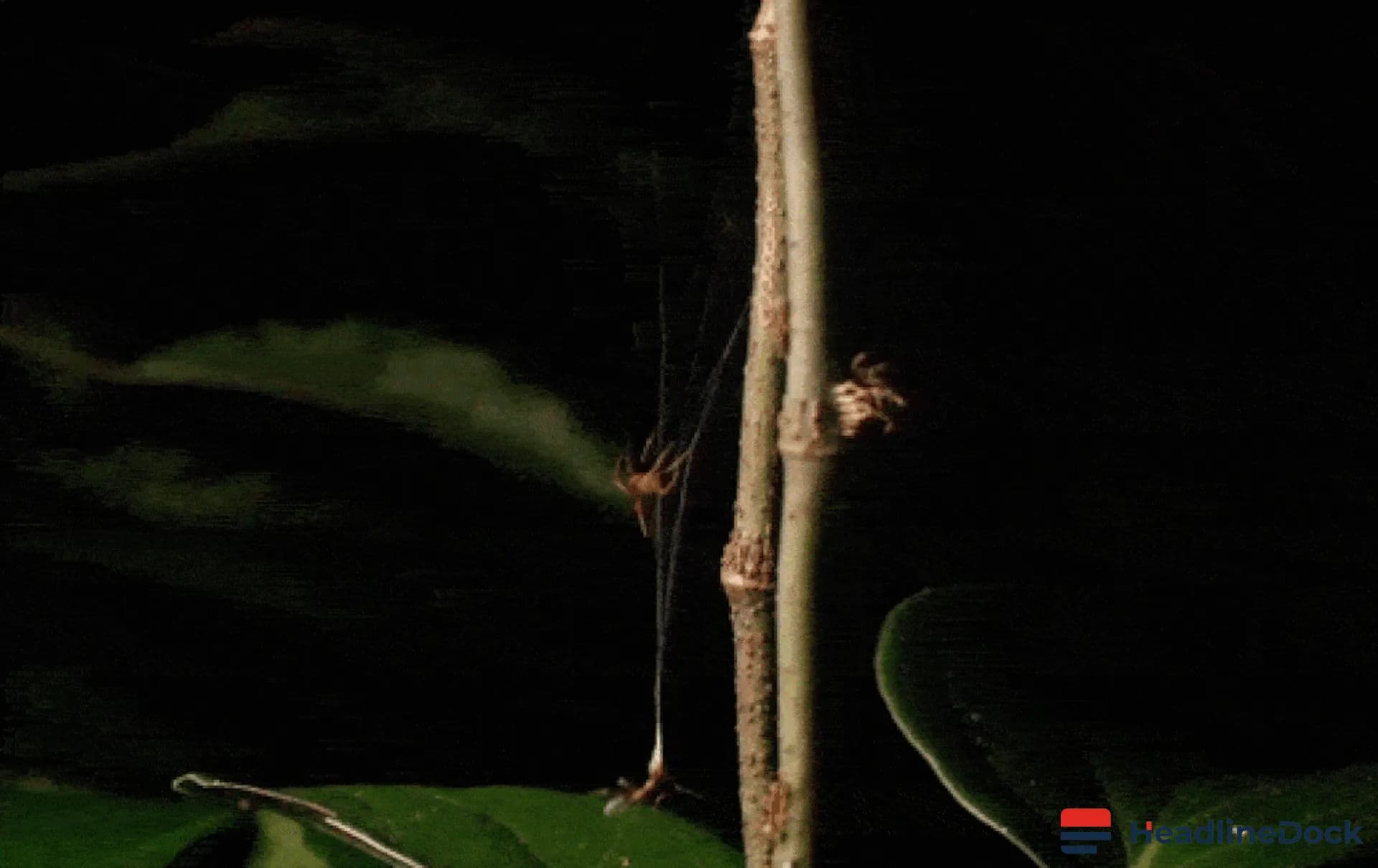
The crossbow spider meticulously constructs its trap after dark. Initially, the spider anchors a series of silk lines in a fan-like arrangement, eventually creating a small, conical frame. This structure is then layered with an extremely fine type of silk. Scientists believe this delicate material may be coated with chemical signals, such as pheromones, designed to provoke an immediate, aggressive response from nearby weaver ants. When a worker ant attacks the cone and bites into the fine silk, it triggers the trap’s release mechanism.
The resulting action is instantaneous. The detached cone acts as a powerful catapult, projecting the ant toward the spider’s main web in a fraction of a second. The force involved in this process is staggering; the ant is launched with an acceleration of up to 1,367 meters per second squared. This equates to approximately 140 times the acceleration of gravity, a force 15 times greater than the extreme g-forces sustained by fighter jet pilots. Once the prey is firmly ensnared in the main web, the spider wraps the ant in silk before feeding.
Biomechanical Superiority and Specialization
This biological trap is considered the most efficient in the world regarding the storage and release of energy within silk. On a gram-for-gram basis, these webs store more energy and exert greater power than any other known biological catapult. Specifically, a single kilogram of this spider's silk can store 78.17 kilojoules of kinetic energy, briefly generating a power output of 11.73 megawatts. This extreme evolutionary adaptation likely allows the spider to rapidly extract ants from their busy trails, preventing other ants from mounting a collective defense.
The crossbow spider exhibits two highly unusual traits: a profound specialization in a single prey species and a trap design triggered by the victim rather than the predator. By focusing exclusively on the weaver ant, the spider has evolved a performance level that demonstrates how extreme environmental pressures can drive the development of extraordinary biomechanical capabilities in the natural world.